Common Structural Defects in Curved Plywood Manufacturing
Technical diagnosis and practical solutions to ensure the structural stability of premium curved plywood components.
Curved plywood manufacturing is a highly specialised process that combines materials engineering, structural mechanics and industrial process control. Producing high-quality curved plywood components — especially for demanding furniture applications — requires strict control over several variables:
- Plywood composition and core species
- Veneer orientation
- Cross-band configuration
- Pressing conditions
- Cooling and stabilisation processes.
When any of these parameters moves outside its optimal process window, geometric deviations and structural defects may appear, compromising the dimensional stability of the final component. Below we examine two of the most frequent structural issues in curved plywood manufacturing, together with their technical causes and practical production solutions.
1. Structural deformation caused by improper cooling
One of the most common defects in curved plywood components is the loss of geometric stability after demoulding. This issue is especially visible in complex furniture components with pronounced curves or ambitious design geometries.
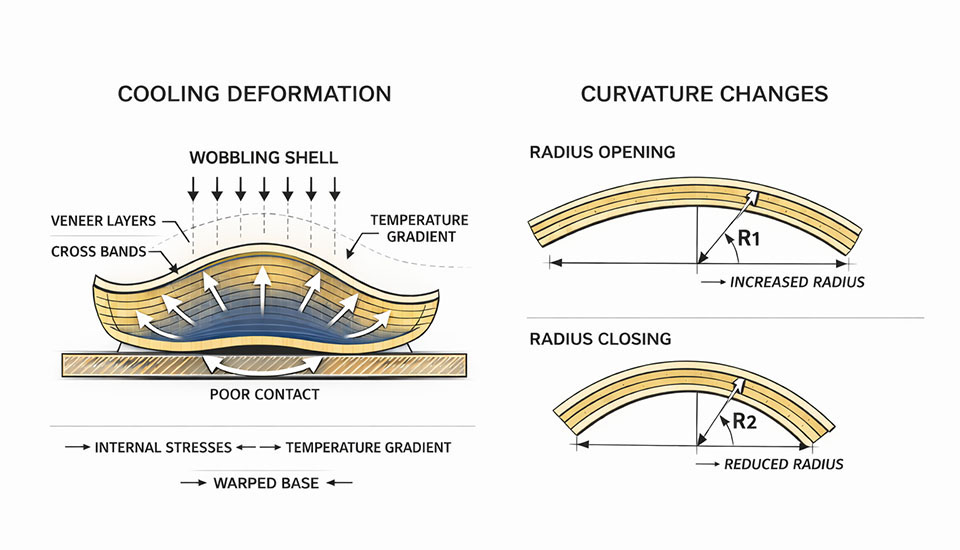
In practical terms, affected parts do not sit evenly on a flat surface, producing what is commonly described in the industry as a “wobbling” shell.
Technical cause
The root cause is typically uneven thermal gradients during the cooling phase.When a component leaves the press, the adhesive system has not yet fully stabilised dimensionally. If heat dissipation occurs asymmetrically, residual internal stresses develop within the laminated structure.
To relieve these stresses, the component may undergo: slight torsion, micro-deformations, small variations in curvature radius… Common causes include: insufficient stacking during cooling, improper stacking geometry, uncontrolled ambient temperature variations, or air currents during stabilisation.
Practical solution
At TALPHER, curved components remain in a controlled-geometry jig (“skeleton”) during cooling, preventing structural relaxation. At the same time, the production environment is stabilised to maintain homogeneous temperature conditions, avoiding draughts and abrupt thermal changes.
2. Excessive opening or closing of the curvature
Another common defect appears when a component changes its radius of curvature after demoulding. Depending on the laminate configuration, the curved shell may either: open (increase curvature radius) or close (reduce curvature radius).
Technical cause
This behaviour usually originates from a structural imbalance within the plywood laminate.In materials engineering terms, it results from an asymmetrical distribution of stiffness between the veneer layers and cross-bands.
If one internal layer presents:
- a higher modulus of elasticity
- higher density
- or different mechanical behaviour
the component may deform when internal stresses are released.
Practical solution
Preventing this defect requires balanced laminate engineering. The goal is to ensure a uniform distribution of longitudinal and transverse stiffness throughout the plywood structure. Achieving the correct veneer-to-cross-band ratio is therefore essential.
Before introducing a new laminate configuration into full industrial production, it is also advisable to validate geometric stability through pilot production runs.
Conclusion
Curved plywood manufacturing is the result of a precise balance between materials science, structural engineering and controlled industrial processes. Most structural defects do not arise from a single parameter, but from the interaction between multiple production variables.
For this reason, achieving premium quality standards requires strict technical discipline throughout the entire manufacturing process. At TALPHER, our curved plywood components are produced under carefully controlled parameters supported by engineering knowledge, production experience and well-defined technical protocols.
This approach allows us to deliver high-performance curved plywood solutions ready for the most demanding international markets.