Veneer Treatment: Key Processes in Curved Plywood Manufacturing
In the furniture industry and the contract sector, the quality of a curved plywood panel is not determined solely by the mould. The structural performance and stability of the curved panels depend on technical processes that take place prior to pressing, such as the selection of wood species and their subsequent treatment.
Improper preparation can lead to critical defects such as cracking, internal stresses, or warping. Below, we analyze the essential steps to achieve high-end curved plywood.
Types of Veneer in Curved Plywood
To understand curved board manufacturing, we must distinguish between two types of wood sheets:
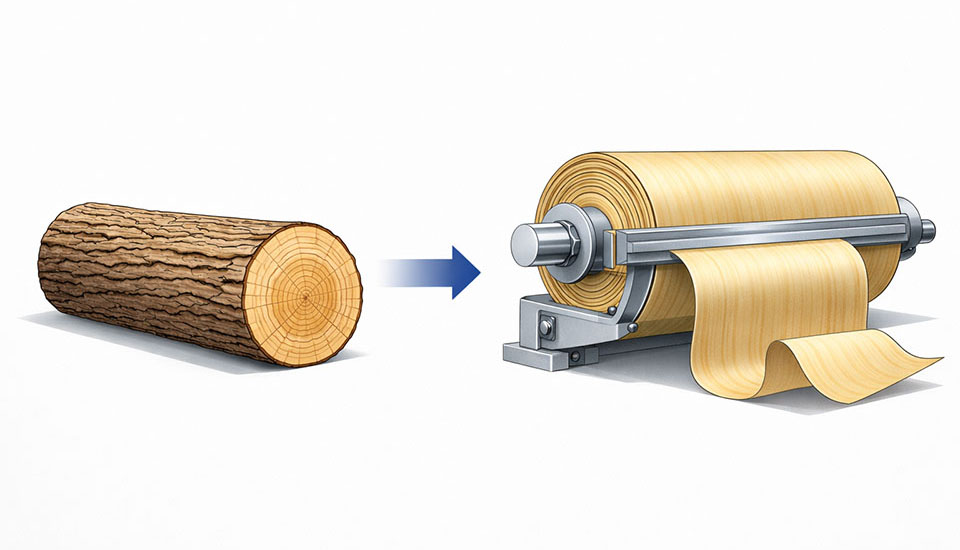
- Rotary Cut Veneer: This is the core of the board and is chosen for its mechanical properties. Its production is unique: a log is held by its ends and rotated against a fixed blade—similar to a giant pencil sharpener—extracting a continuous sheet of millimeter thickness.
- Fine or "Face" Veneer: This acts as the "dress" or aesthetic finish of the curved component. Highly valued hardwoods such as American walnut, European oak, or ash are used.
Species Selection for Structural Curving
The choice of Wood veneer for the interior is the primary technical parameter in molded board manufacturing. The most common species are beech, sycamore, and birch. Each species provides different variables that affect the final result:
- Strength and Elasticity: Differentiated behavior regarding compression and traction during the curved plywood process.
- Edge Aesthetics: The appearance of the board's edge is crucial in designs that demand premium quality.
Veneer Preparation: The Secret to Stability
To obtain a superior quality product, cutting the veneer to size is not enough. It is essential to perform strict quality controls to guarantee the flatness of the material.
In curved board manufacturing, the rotary-cut wood sheets are placed into a hot plate press before being glued. This pre-pressing process eliminates wrinkles and ensures the veneer is as flat as possible, thus preventing the appearance of "bufas" (air pockets) or cracks in the edges of the final board.
Technical Conclusion on Curved Components
Excellence in industrial bending is the result of rigorous decisions made during the preparation phase. The geometric stability and durability of the bent plywood panel depend on this comprehensive technical approach, which begins with the selection of the wood species that will form the core of the product, as well as its subsequent treatment prior to being placed in the mould.