What is the difference between HPL, CPL and natural veneer on a curved part?
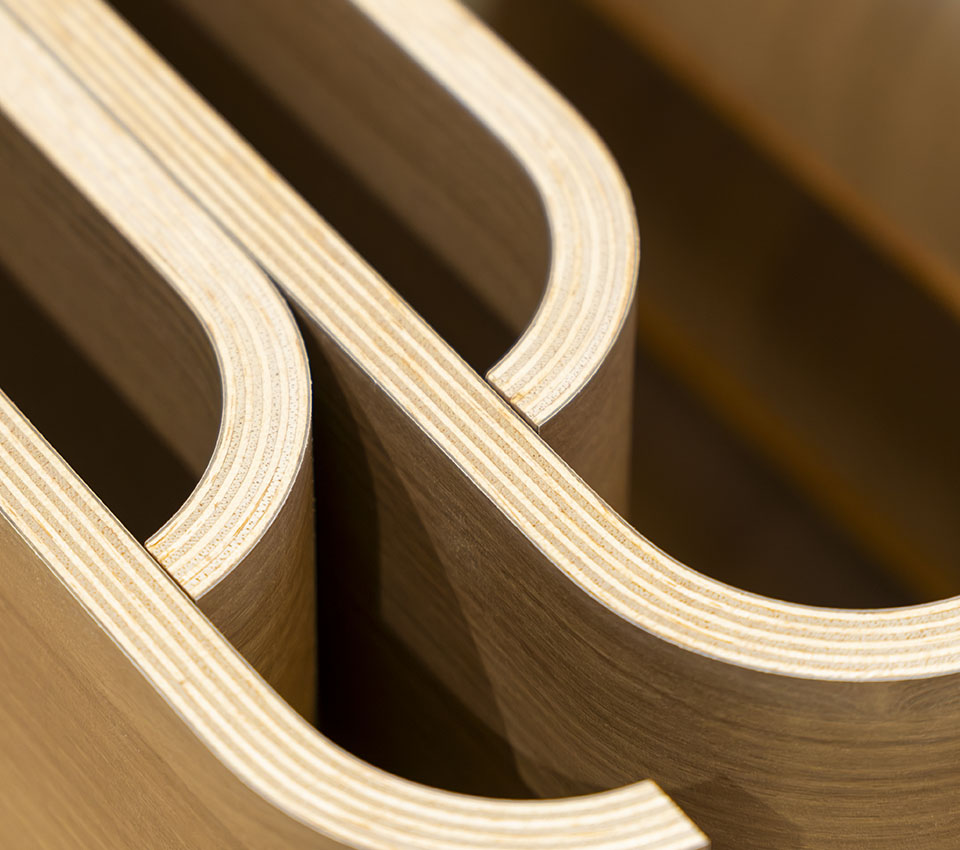
When a piece of furniture, cladding or architectural element requires a decorative finish on a curved surface, choosing between HPL, CPL and natural veneer is not simply an aesthetic decision.
The selected material directly affects the bending capability, minimum achievable radius, surface resistance, manufacturing process and final appearance of the part.
In this article, we explain the main differences between HPL, CPL and natural veneer when used on curved parts, their advantages and limitations, and when each solution is most appropriate.
What are HPL, CPL and natural veneer?
Before comparing their performance on curved parts, it is important to understand the characteristics of each material.
HPL (High Pressure Laminate) is a decorative high-pressure laminate made from several layers of resin-impregnated paper pressed together under high pressure. It is known for its resistance to wear, impact and certain chemicals.
CPL (Continuous Pressure Laminate) is a decorative laminate manufactured through a continuous production process. It is commonly available in thinner gauges and may offer greater flexibility than certain HPL products, making it interesting for some curved applications.
Natural veneer is a thin layer of real wood. It retains the natural characteristics of the selected species, including grain, colour, texture and natural variation.
Can HPL, CPL and natural veneer be used on curved parts?
Yes, but each material behaves differently when subjected to curvature.
On a curved part, the finish must follow the geometry of the substrate without cracking, delaminating, generating excessive stress or losing its aesthetic properties.
For this reason, the bending radius is one of the most important factors when selecting the material.
HPL on curved parts
HPL is known for its high surface resistance and is widely used in furniture, interior architecture, retail, contract projects and other demanding applications.
However, conventional HPL is relatively rigid. As a result, its use on tight radii may be limited.
When considering HPL for a curved part, it is necessary to evaluate:
- Laminate thickness.
- Bending radius.
- Direction of the curve.
- Specific HPL product.
- Substrate.
- Adhesive and pressing system.
- Manufacturer's technical recommendations.
Therefore, it cannot be assumed that every HPL product is suitable for every curved application.
Main advantage: high surface resistance.
Main limitation: limited ability to adapt to certain tight curves.
CPL on curved parts
CPL can be an interesting option when a decorative finish needs to combine good surface performance with greater adaptability to certain curved geometries.
Its lower thickness compared with some HPL products can make it easier to use on curved surfaces, rounded edges and enveloping shapes.
Key characteristics include:
- Good adaptability to certain curves.
- Wide range of colours and designs.
- Good performance for furniture and interior applications.
- Potential for visually continuous surfaces.
- Reduced thickness in certain applications.
However, not every CPL product is suitable for every radius. The minimum bending radius depends on the product, thickness, orientation, substrate and manufacturing process.
Main advantage: a balance between design, performance and adaptability.
Main limitation: it may not provide sufficient performance for certain highly demanding applications.
Natural veneer on curved parts
Natural veneer offers a distinctive characteristic: it is real wood.
It consists of a thin layer of wood that can be applied to different substrates, including curved substrates, using manufacturing systems specifically designed for these geometries.
Natural veneer allows designers to work with:
- Different wood species.
- Grain direction and continuity.
- Veneer leaf matching.
- Different surface finishes.
- Lacquers, oils and other protective systems.
Each piece may also present natural variations in colour, grain and texture, giving the finished product a unique character.
Main advantage: the authenticity and aesthetic value of real wood.
Main limitation: greater natural variation and the need for careful control of the finish and surface protection.
HPL vs CPL vs natural veneer comparison
Feature |
HPL |
CPL |
Natural veneer |
Material |
High-pressure decorative laminate |
Continuous decorative laminate |
Natural wood |
Surface resistance |
Very high |
High |
Depends on finish |
Flexibility |
Low-medium* |
Medium-high* |
High* |
Adaptability to curves |
Product-dependent* |
Good for certain applications* |
Good with a suitable system* |
Appearance |
Uniform |
Uniform |
Natural and unique |
Wood grain |
Reproduction |
Reproduction |
Real wood grain |
Variation between parts |
Very low |
Very low |
Natural |
Maintenance |
Easy |
Easy |
Depends on finish |
Demanding applications |
Excellent |
Very good |
Depends on finish |
Real wood appearance |
No |
No |
Yes |
* Actual bending capability depends on the product, thickness, radius, substrate, orientation and manufacturing system. Always check the manufacturer's technical specifications.
Which material is best for a curved part?
There is no universal answer. The right choice depends on the characteristics of the part and the required performance.
HPL: when surface resistance is the priority
HPL can be the right choice when the surface will be exposed to intensive use and high wear resistance is required.
Typical applications include:
- Counters.
- Commercial furniture.
- Hotels and restaurants.
- Contract interiors.
- Interior equipment.
- High-wear surfaces.
For curved parts, it is essential to select an HPL product compatible with the required radius.
CPL: when balance is the priority
CPL can be interesting when the project requires a combination of resistance, design variety and adaptability to certain curved forms.
It can be used for:
- Rounded edges.
- Soft radii.
- Curved furniture.
- Enveloping elements.
- Continuous decorative surfaces.
Natural veneer: when wood aesthetics are the priority
Natural veneer is particularly suitable for projects seeking a premium appearance and the authenticity of real wood.
It can be used for:
- High-end furniture.
- Hotels.
- Restaurants.
- Executive offices.
- Residential interiors.
- Bespoke architectural elements.
On curved parts, grain direction can also be used as a design element to visually emphasise the geometry.
The bending radius is critical
A part with a 500 mm radius does not present the same technical requirements as one with a 50 mm radius.
The smaller the radius, the greater the demands placed on the material and construction system.
Before selecting the finish, it is advisable to determine:
- Internal bending radius.
- External radius, where applicable.
- Finish thickness.
- Type and thickness of the substrate.
- Direction of the curve.
- Adhesive system.
- Pressing system.
- Intended use of the part.
For curved projects, it is therefore advisable to define the geometry and performance requirements first and select the finishing system afterwards.
Which finish provides the best aesthetic result?
It depends on the design objectives.
HPL and CPL offer a wide range of colours, textures and designs, including wood, stone, metal and other decorative effects.
Natural veneer, however, provides something that no printed laminate can reproduce exactly: the grain and texture of real wood.
On a curved part, this characteristic can become a key element of the design.
What about the edges?
Edge treatment is particularly important on curved parts.
It is not enough for the material to follow the main surface. The following aspects must also be properly resolved:
- Exposed edges.
- Surface transitions.
- Changes in radius.
- Joints.
- Design continuity.
- Sealing and protection.
A properly finished curved part is therefore the result of a complete construction system, not simply the choice of a decorative material.
HPL, CPL or natural veneer: which one should you choose?
As a general guideline:
HPL → maximum surface resistance.
CPL → balance between flexibility, resistance and design.
Natural veneer → maximum authenticity and aesthetic value of real wood.
However, for a curved part, the final decision should be based on the bending radius, substrate, thickness, manufacturing process and intended use.
Conclusion
The difference between HPL, CPL and natural veneer on a curved part goes far beyond appearance.
HPL stands out for its surface resistance; CPL can provide a good balance between design, resistance and adaptability to certain geometries; and natural veneer provides the authenticity and expressive character of real wood.
There is therefore no universally better material for curved parts. The right solution is the one that correctly combines bending radius, substrate, finish, performance and manufacturing process.
Before manufacturing a curved part, it is advisable to consult the product's technical data sheet and specifically verify the minimum bending radius allowed for the selected material and thickness.
Frequently asked questions
Can HPL be curved?
Yes. Certain HPL products can be used in curved applications, but the minimum radius depends on the product, thickness and manufacturing system. Not all HPL products are suitable for tight curves.
Is CPL more flexible than HPL?
In general, certain thinner CPL products may adapt better to some curved geometries than conventional HPL. However, the manufacturer's specifications should always be checked.
Can natural veneer be applied to curved surfaces?
Yes. Natural veneer can be applied to curved substrates when the construction system and application process are designed for the required geometry.
Which is more resistant, HPL or natural veneer?
HPL generally provides greater resistance to wear and intensive use as a surface finish. Natural veneer can also achieve good performance with an appropriate protective finish, although its behaviour depends on the complete system.
What is the best option for high-end curved furniture?
If authenticity of real wood is the priority, natural veneer is often an especially attractive solution. If resistance and ease of maintenance are the priorities, a high-performance laminate may be more appropriate.
What information is needed to choose the right material?
At a minimum, it is advisable to know the bending radius, part dimensions, substrate, available thickness, intended use and desired finish.